Safety Regulations
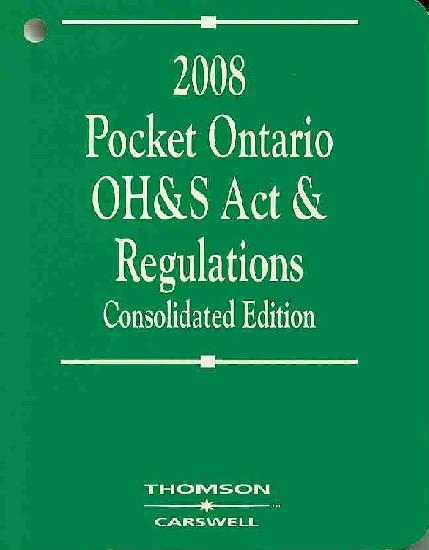 | Legislation Each province of Canada has its own legislation containing regulations in regards to the workplace health and safety of the forestry industry. The regulations are intended for the employers, employees and machines. The employers are held accountable for the safety of their workers by ensuring safe work habits and properly maintained equipment. The employees must be appropriately trained and qualified to operate forestry machinery. The legislations also provide measures for inspecting the performance of the forestry machinery. The following are the Canadian provincial regulations. These regulations must be practiced in order to maintain a safe work environment. |
The Ontario Occupational Health & Safety Act
Logging is covered in Regulation 851 s. 103-119. The regulation contains training requirements for both employees and employers/supervisors. For example Reg. 851 s. 105(1)(1) states:
'1. Every employer shall establish and maintain the following training programs, approved by the Ministry of Training, Colleges and Universities:
1. For cutters and skidder operators,
i. Cutter-Skidder Operator (program #P750000),
ii. Cutter (program # P750010), and
iii. Skidder-Operator (program # P750020) '.
Section 106.2 (1) also states: ' The employer shall ensure that every worker who supervises the operation of mechanical harvesting equipment has successfully completed Mechanical Harvesting Equipment Operator - Common Core (program # P750025) before performing supervisory work relateing to mechanical harvesting equipment.'
The regulation also outlines safety regulations required in felling trees (s. 107-110), skidding (s. 112) as well as road hauls (s. 113-119). Definitions to all pertinent terms are defined in section 103 of the Industrial Establishments Regulation.
Safety Regulations By Province
|
Provincial Legislation |
Regulation |
Online Reference |
|
|
Regulation 851 Industrial Establishments – Logging Section 103-119, p. 616-623 in the Pocket OHSA 2009 ed. |
http://www.e-laws.gov.on.ca/html/regs/english/elaws_regs_900851_e.htm#BK16 |
|
|
Forestry - Part 34 |
http://employment.alberta.ca/documents/WHS/WHS-LEG_ohsc_2009.pdf |
|
|
Forestry Operations and Similar Activities – Part 26 |
http://www2.worksafebc.com/Publications/OHSRegulation/Part26.asp |
|
|
Forestry and Arboriculture – Part 40 | http://web2.gov.mb.ca/laws/regs/pdf/w210-217.06.pdf |
|
|
General Regulations - Part XXI Logging and Silverculture Operations |
http://www.gnb.ca/0062/PDF-regs/91-191.pdf |
|
|
Powered Mobile Equipment - Part XII, Section 250-279 |
http://www.assembly.nl.ca/legislation/sr/annualregs/2009/nr090070.htm |
|
|
General Regulations - Part 41 Forestry Operations |
http://www.gov.pe.ca/law/regulations/pdf/O&01G.pdf |
|
|
Regulation respecting forestry operations |
http://www.canlii.org/en/qc/laws/regu/rq-c-s-2.1-r22/latest/rq-c-s-2.1-r22.html |
|
|
Forestry and Mill Operations - Part XXVIII, section 389-409 |
http://www.qp.gov.sk.ca/documents/English/Regulations/Regulations/O1-1R1.pdf |
|
|
Forestry Operations and Wood Products - Part 12 |
http://www.gov.yk.ca/legislation/regs/oic2006_178ENG/part12.pdf |
* No Occupational
Health and Safety Regulations specific to Forestry in the
The Ontario
Forestry Safe Workplace Association is dedicated to working with the businesses
in forestry in order to provide the safest workplaces with zero fatalities and
injuries. The association provides superior training, consultation and related
services to forestry businesses in addition to ergonomic safety solutions and
practices. In partnership with
|
 Link to OFSWA.on.ca |
 Link to BCForestSafe.org | BC Forestry Safety Council The British
Columbia Forestry Safety Council is a non-for-profit organization that was
created in September 2004. It is supported by Worksafe
|
Breakthrough Technology Training Simulation Training simulators allow trainees to have a hand-on experience before going out into the field. Training is essential due to the growing complexities of the forestry procedures and machinery. These simulators are an innovative way to allow the trainee to get a sense of the difficulty and meticulous nature of some of the machinery. It instills confidence in the trainee which will help to reduce workplace injuries by increasing their experience in operating; it is critical for employees to be well experienced on a machine in order to operate the machines safely and effectively. Providing simulation tools in training courses will be cost-effective, provide high-quality training to remote areas and broaden the possibilities of training procedures. It will allow operators to learn more quickly and efficiently about how the equipment is used. There are many types of simulation technologies ranging from inexpensive CD-ROM software to equipment based simulations.(Industry Canada, 2009)
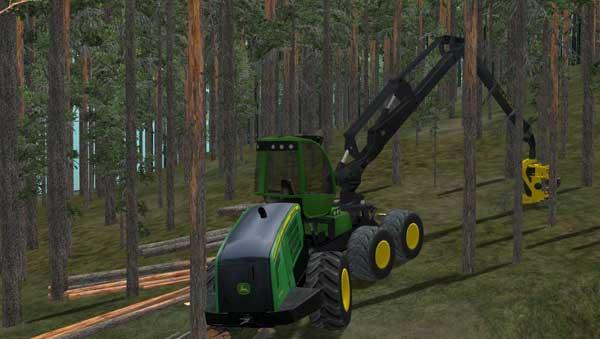 | 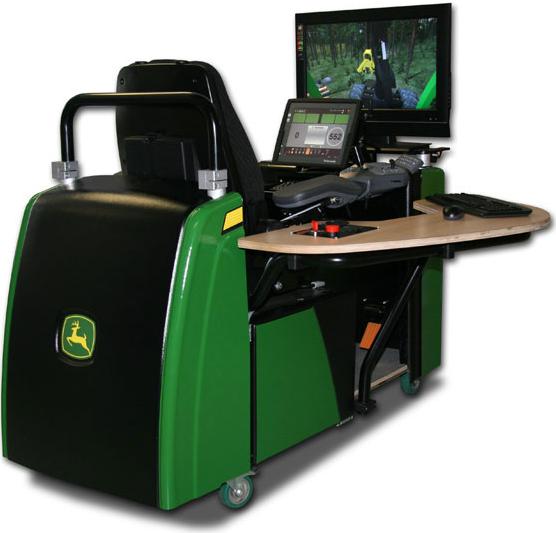 (Deere.com, 2009)
For some videos of real simulators in action go to the "Additional Information" page. |
